Car cooling systems rely on a sealed network of hoses to pump coolant/antifreeze around an engine. These hoses are arranged in a sealed loop, which allows a smooth and constant flow of coolant/antifreeze to reach components including the head gasket, cylinder heads and engine block – keeping the engine working at the right temperature.
When air is allowed to enter this sealed system, blockages and bubbling can occur, which can lead to the engine overheating. There are several possible causes for air pockets in the cooling system, and we’ll cover these as part of our guide on what it means when coolant/antifreeze bubbles in the system.

Why is my car’s coolant bubbling?
Cooling systems in most cars are pressurised, and rely on a leak-free closed circuit of hoses to pump coolant/antifreeze around the engine. When air gets into this sealed system, air pockets can form and cause blockages, which can lead to bubbling and overheating.
Bubbling indicates rising air pressure in the cooling system, which is a sign that the flow of liquid is blocked by a pocket of air. One of the most common causes is a blown head gasket, in which the air pressure inside the cylinder heads is transferred to the cooling system. This escaped air causes bubbling in the coolant/antifreeze reservoir, which can often be mistaken for boiling.
Aside from a blown head gasket, there are several other causes for air inside in the cooling system, which we’ll come to later.
Why does air in the cooling system cause overheating?
When there’s a leak in the cooling system, the pressure of the liquid drops and so does the boiling point of the coolant/antifreeze. Cooling systems are pressurised to raise the boiling point of the fluid, with the pressure cap and the overflow helping to raise the temperature at which the coolant/antifreeze boils.
In the case of a blown head gasket, air enters the cooling system and causes bubbling. At the same time, coolant/antifreeze flows into the cylinder head through the leak in the head gasket. This means that the cooling system steadily fills with air as the liquid leaks into the cylinders, reducing the liquid pressure of the system which causes the fluid to reach boiling point. With a head gasket leak, overheating can happen rapidly, with white steam pouring from beneath the bonnet.
Whether it’s a faulty pressure cap or crack in the engine block, if the pressure at which the coolant/antifreeze flows through the engine is affected by a leak, the fluid will reach boiling point causing the engine to overheat.
Does coolant bubbling mean that my coolant is boiling?
Coolant bubbling (not boiling) is often caused by combustion gases entering the cooling system (commonly from a head gasket failure), though trapped air or low coolant levels can also contribute. Common places for exhaust gas to enter the cooling system are via a leaking head gasket, a cracked block, or a warped cylinder head. In time, this can lead to your engine’s temperature rising to the coolant’s boiling point. Bubbling can be a sign of serious underlying issues and should not be ignored, even if the coolant is not yet boiling.
You should take your car to a mechanic to perform a leak test should you notice these symptoms arising so that they can determine the specific cause and act accordingly.

Can I drive my car if my car’s coolant is bubbling?
If you notice your car’s coolant bubbling, we would recommend pulling over immediately and having your vehicle recovered and taken to a garage to solve the problem before the engine is damaged irreparably.
Damage to the engine or cooling system is not only potentially dangerous, but it can be very expensive to repair, which is why you should attempt to avoid it at all costs.
What is the boiling point of coolant/antifreeze?
The point at which coolant/antifreeze boils depends on the quality of the product itself, and the pressure maintained inside the cooling system. At normal operating pressure, Prestone Coolant/Antifreeze has a boiling point of 129°C, and a freezing point of -37°C.
However, if the pressure inside the cooling system is compromised by a leak in the cooling system or a faulty component, such as a blown head gasket, the boiling point of the coolant will fall as the pressure inside the system drops.
That’s why, when your car has a fault or leak, overheating can occur and the coolant/antifreeze can boil in the system.
How does air get in the cooling system and how can I fix it?
As touched on above, there are several reasons why air can get into the cooling system, and these range from minor issues to severe mechanical problems. Below, we list some of the areas prone to fault that can let air into the system, and offer practical advice on how to fix it.
Head Gasket
When a head gasket blows, compressed air from the cylinders can rapidly enter the cooling system, leading to bubbling in the reservoir and coolant/antifreeze seeping into the cylinder head. If you notice bubbling along with overheating or warning lights, you should stop driving as soon as it is safe and have the vehicle inspected by a professional as soon as possible.
Symptoms
- Overheating
- Bubbles in the coolant/antifreeze reservoir
- White smoke from the exhaust
- Billowing steam from under the bonnet
The fix
Getting the leak fixed by a professional is one option. This can be expensive though, so if you want to save some money you could use a leak repair fluid at home. These do provide safe, permanent repairs – just follow the instructions carefully.

Cooling System Pressure Cap
To maintain pressure, cooling systems rely on a pressurised cap that keeps the system at a constant pressure while allowing coolant/antifreeze to flow to the expansion reservoir. If the cap develops a fault or is replaced with one that’s not compatible with the system, air can get into the system and cause problems.
Symptoms
- Bubbling in the coolant/antifreeze reservoir
- Bubbles around the cap seal
- Overheating
The fix
If a fault develops with the pressure cap, it will need to be replaced before the pressure change can cause damage to the radiator. Make sure the cap is replaced with an OEM (original equipment manufacturer) component, or one directly recommended by the manufacturer.
Air Pockets in the Radiator
Air pockets in the radiator can cause blockages as coolant/antifreeze circulates through the engine. These usually happen after a coolant/antifreeze flush, when not enough coolant/antifreeze is added to the system to expel any remaining air.
Symptoms
- Bubbling in the reservoir.
- Higher operating temperature, which could lead to overheating.
- Potential radiator damage.
The fix
When flushing the radiator and cooling system, make sure you run the engine with the pressure cap off for 15 minutes after refilling the system. This will bleed any air from the radiator and cooling system before you replace the pressure cap. However, it is important to consult the manufacturer’s recommended bleeding procedure, as some systems require specific steps to safely remove trapped air.
Low Coolant Level
Coolant is responsible for ensuring that the temperature of the engine doesn’t drop too low or rise too high, low levels of this can lead to several issues such as overheating and potentially broken components.
Symptoms
- Bad fuel economy
- Loss of acceleration
- High-temperature gauge getting close to the red
The fix
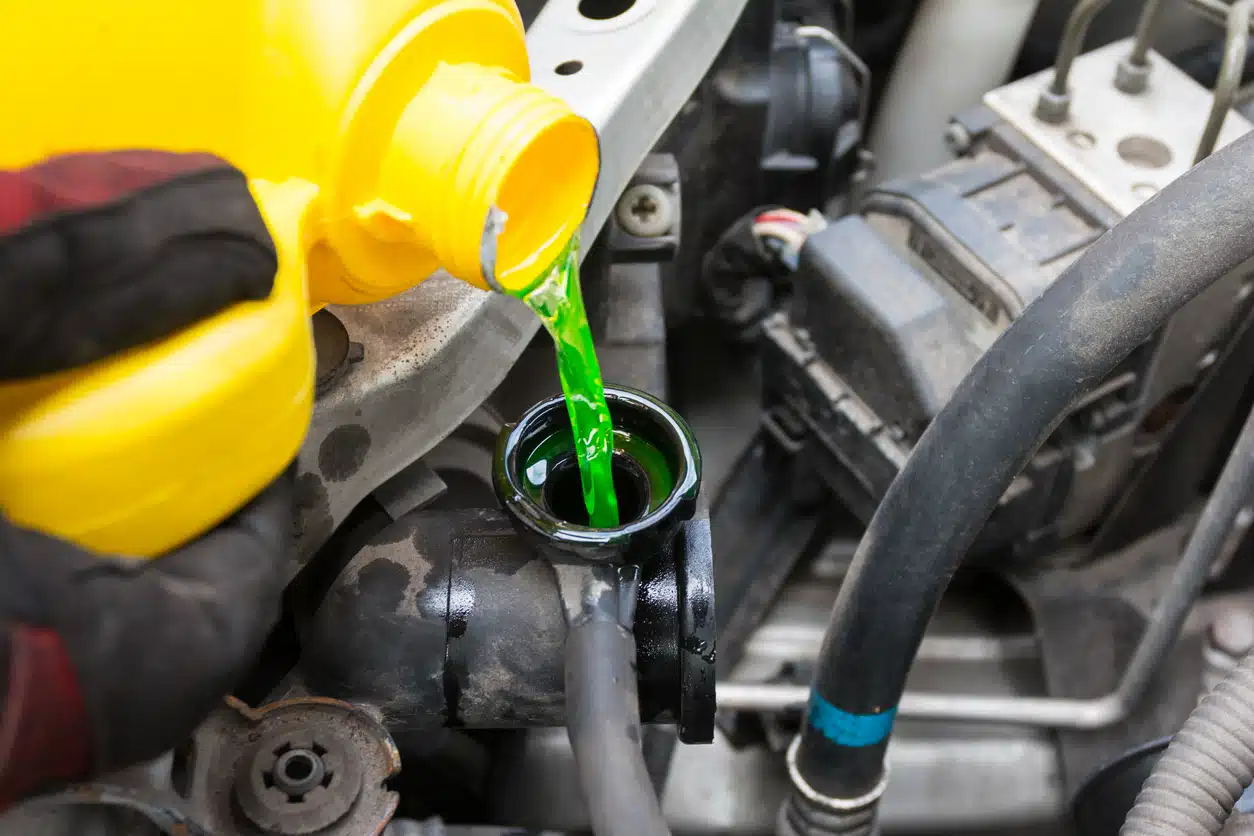
If you notice that your coolant is low, you should consult the owner’s manual to see which coolant your car’s engine needs. You should then top up the coolant level with a 50/50 mixture of water and coolant.
Malfunctioning Water Pump
A water pump in a car’s cooling system is responsible for pushing the coolant through the system so that it can dissipate the heat and get to the components needed.
Symptoms
- Leaking coolant
- Overheating
- Squealing/whining noise
- Corrosion
The fix
Depending on the problem at hand, there could be a variety of fixes. The fix could be as simple as reapplying sealant or tightening the parts, or as drastic as completely replacing the pump. Your mechanic will be able to recommend the appropriate action based upon what they find in an inspection.

My coolant is overflowing because it’s bubbling – what do I do?
If your coolant is overflowing because it is bubbling, it could be caused by several issues, including overheating, a faulty pressure cap, or in more serious cases, a head gasket failure.
The head gasket is responsible for sealing the combustion chambers so that appropriate pressure can be maintained for maximum power. If the head gasket has blown, coolant will also spill out of the engine causing temperatures to spike and the remaining coolant to start to bubble.
The only way to fix a blown head gasket is to completely replace it as it is almost impossible to repair due to the high pressure job that it does.
Will burping the coolant system help?
Burping your system is a way to remove the air from the cooling system via the radiator filler neck. While it will effectively remove bubbles from your cooling system, it won’t fix the underlying cause of the issue.
If you do not fix the underlying issue causing the bubbling, in time the bubbles will return and cause you yet another headache.
Read our comprehensive guide on how to do a coolant flush.
At Prestone, our coolant/antifreeze is tested in all extremes, so you can trust it to take care of your car’s engine and cooling system all year round.