Ready to Use Coolant / Antifreeze
Prestone’s Ready to Use Coolant/Antifreeze is a high-quality coolant/antifreeze suitable for all makes and models. It requires no dilution for easy use when you need it most.
- Brand new patented technology with 17 new patents
- All makes, all models, all engines – guaranteed
- Protects against corrosion
- Preserves engine health
- Guaranteed for 10 years
- Protection for up to 300,000 miles or 480,000km
- Used as a first fill by multiple leading vehicle manufacturers
- Safely mixes with any colour or specification of coolant/antifreeze
Coolant/antifreeze should protect against extreme temperatures while maintaining peak engine performance – Prestone Coolant/Antifreeze does both.
Using our unrivalled expertise in coolant/antifreeze, we developed Prestone coolant to withstand temperatures from -37°C to 129°C, making it suitable for all cars and weather conditions.
If your coolant/antifreeze needs topping up or replacing, it can be difficult to know which colour or type to use. Mixing incompatible coolants or using the wrong one for your car can cause clogging and damage.
Prestone is guaranteed for all cars and can be mixed with any other colour of coolant/antifreeze, making it the best choice for you. You can use it to top up your car or to refill the cooling system after it has been fully drained and flushed.
Long-term peace of mind is delivered with Prestone’s Ready to Use Coolant/Antifreeze because of the 10-year or 300,000-mile guarantee.
- All makes, all models, all engines – guaranteed
- Protects against corrosion
- Guaranteed for 10 years
- Protection for up to 300,000 miles or 480,000km
- Used as a first fill by multiple leading vehicle manufacturers
- Safely mixes with any colour or specification of coolant/antifreeze.
Product Name: Prestone Coolant/Antifreeze Ready to Use 1 Litre
Manufacturer’s Code: PAFR0035B
Product Name: Prestone Coolant/Antifreeze Ready to Use 4 Litres
Manufacturer’s Code: PAFR0038B
Compatibility Guarantee: Click to Download
How to Use:
This coolant is suitable for all makes and all models of vehicles. It also mixes with any existing coolant currently in the system.
Lift up the bonnet using the bonnet release lever located in the footwell. Prop the bonnet up, and locate the coolant reservoir. The coolant reservoir is attached to the coolant radiator, so you can find it by following the thick rubber hose from the radiator.
Once the reservoir has been identified, wait until you’re certain that the engine is cool before opening the reservoir. The reservoir is pressurised, so the extremely hot liquid can explode if opened when hot.
Next, check the level of the reservoir using the min & max guidance, and top up as necessary.
SDS InformationYes. Thanks to its unique and patented formula, Prestone Coolant/Antifreeze can be safely mixed with another product within the cooling system without causing damage or gelling. It’s also guaranteed to be compatible with all cars, vans, or light trucks.
That means there’s no need to flush your car’s cooling system before adding Prestone Coolant/Antifreeze. Simply pour the product into your coolant reservoir – it’s that easy.
You can in a pinch, but it’s much better to use distilled or de-ionised water. That’s because regular tap water contains minerals that can form hard deposits within the cooling system, increasing the risk of premature wear and tear of internal components, as well as reducing the lifespan of the coolant/antifreeze itself.
Yes, you can, so long as the coolant/antifreeze you’re using is based on ethylene glycol and is free from silicates. Some car coolants contain silicates and other compounds that can be harmful to motorcycle engines, so it’s super important that you read what a product contains before adding it to your bike.
If in doubt, always refer to your motorcycle’s manual, where you’ll find information on the correct type of coolant/antifreeze to use.
Generally, no. A sealed bottle of coolant/antifreeze has a 10 year shelf life, while an opened bottle can be stored safely for years and years without spoiling. As such, you’re unlikely to see an expiration date on any coolant and antifreeze-containing engine fluids.
With that said, it’s important to store coolant/antifreeze safely while adhering to the instructions on the product packaging. The fluid should remain in its original container and not be exposed to extreme variances in temperature. Ensure that the lid is securely fastened at all times, too, or it could present a hazard for children as well as animals.
Your car’s coolant/antifreeze reservoir should be easy to identify by its coloured lid, with many cars having a yellow coolant/antifreeze cap. You’ll probably find that there’s a warning symbol on the cap too, which highlights the danger of unscrewing the cap when the engine is running or hot.
The reservoir itself is usually made of thick, semi-translucent white plastic, and you should be able to see the coloured coolant/antifreeze (often pink, yellow, or green) through the side of the tank.
If you’re struggling to find your car’s coolant reservoir, the best thing to do is refer to the owner’s manual, which will have a diagram showing different parts and components under the bonnet. If you no longer have the manual, head online and visit the manufacturer’s website or forums dedicated to the make and model of your car — a fellow motorist should be able to point you in the direction of the coolant reservoir for your specific type of car.
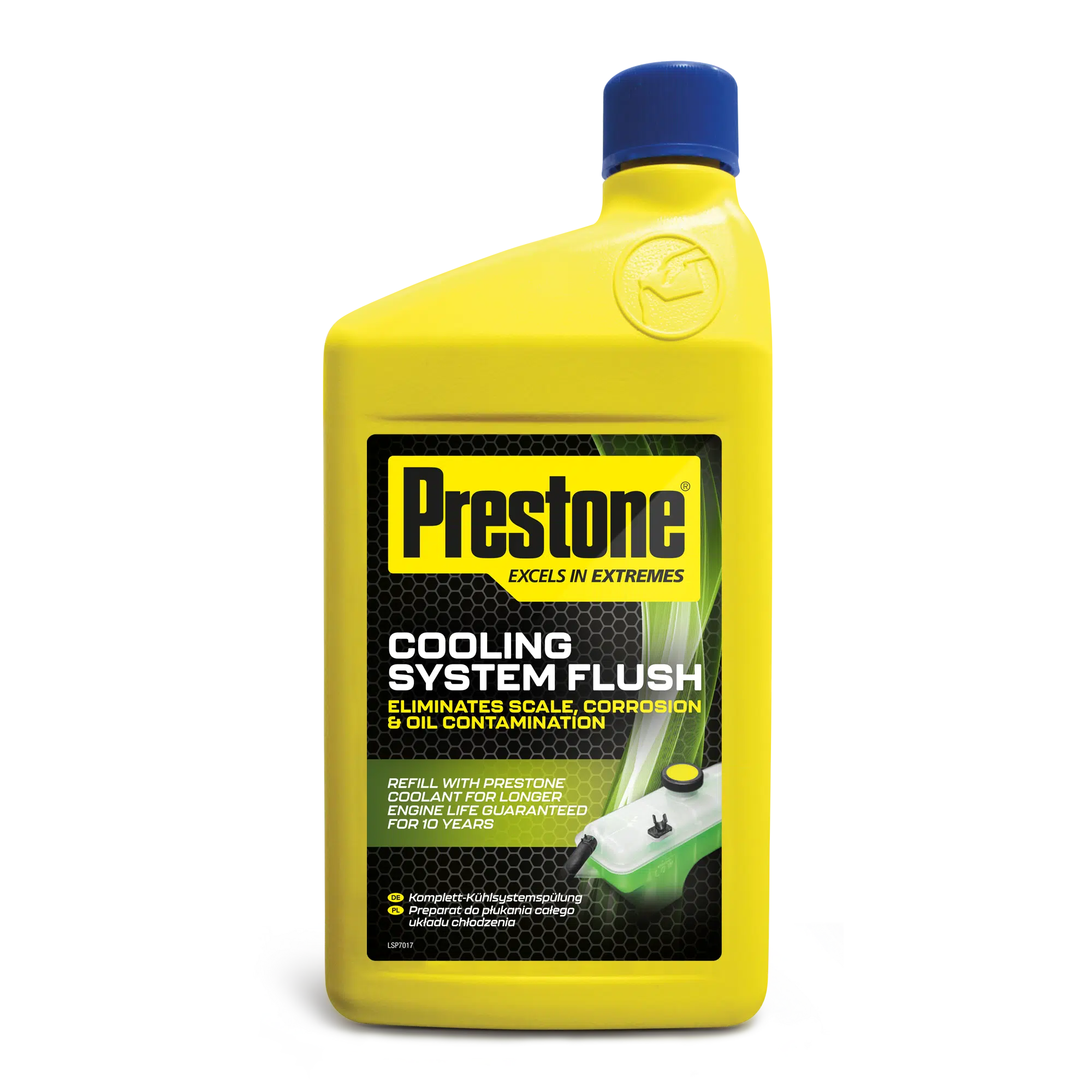
You don’t technically ‘replace’ Prestone Cooling System Flush. It’s a single-use cleaner that helps remove contaminants and limescale from the cooling system when flushing the radiator.
Here’s how to use it:
- Drain the old coolant/antifreeze from the cooling system. If you’re not sure how, read our comprehensive guide on how to do a coolant flush.
- Replace the radiator drain valve and add Cooling System Flush to the coolant reservoir. Don’t replace the cap.
- Start the car and let the engine run for 5-10 minutes. This will circulate the product through the system, where it will lift contaminants and limescale.
- Switch off the engine and allow it to cool. Then, repeat the steps you took to drain the soiled cleaning solution from the system.
- From there, it’s a case of topping up your car with high-performance coolant/antifreeze.
Just like checking your oil or your tyre pressure, making sure your car’s coolant/antifreeze is protecting your car as it should be is an important part of maintenance. Without it, you run the risk of overheating since there’s nothing to absorb the heat produced when the car is in use.
Fortnightly check-ups are something we really recommend at Prestone, to see if the coolant/antifreeze needs topping up and also to test if it’s protecting your vehicle.
If you find that you need to top it up, here’s a helpful guide.
- Start by locating the coolant/antifreeze reservoir; this is usually visible on either side of the engine bay under the bonnet and is identifiable by the brightly coloured liquid inside. When adding Prestone, it is important to ensure the engine has cooled before unscrewing the cap of the expansion tank as the coolant operates at around 90°C. Prestone Coolant/Antifreeze should be added straight into the cooling system through the expansion tank.
- When adding coolant/antifreeze, it is important to ensure the engine has cooled before unscrewing the cap of the expansion tank as the coolant operates at around 90°C.
- Prestone Coolant/Antifreeze should be added straight into the cooling system through the expansion tank.
- After filling with Prestone, make sure that the cap of the expansion tank is replaced and tightened.
Just like checking your oil or your tyre pressure, making sure your car’s coolant/antifreeze is protecting your car as it should be is an important part of vehicle maintenance. Without it, you run the risk of overheating since there’s nothing to absorb the heat produced when the car is in use.
Fortnightly check-ups are something we really recommend at Prestone, to see if the coolant/antifreeze needs topping up and also to test if it’s protecting your vehicle.
If you find that you need to top it up, here’s a helpful guide.
- Start by locating the coolant/antifreeze reservoir. This is usually visible on either side of the engine bay under the bonnet and is identifiable by the brightly coloured liquid inside.
- When adding coolant/antifreeze, it’s important to ensure the engine has cooled before unscrewing the cap of the expansion tank as the coolant operates at around 90°C.
- If you are using a Ready to Use Prestone Coolant/Antifreeze, it should be added straight into the cooling system through the expansion tank.
- Locate the ‘min’ and ‘max’ markers on the side of the coolant expansion tank. Ideally the fluid level should be kept at the ‘max’ marker at all times.
- After filling with Prestone Coolant/Antifreeze, make sure that the cap of the expansion tank is replaced and tightened.
Coolant/antifreeze should protect against extreme temperatures while maintaining peak engine performance – Prestone Coolant/Antifreeze does both.
Using our unrivalled expertise in coolant/antifreeze, we developed Prestone coolant to withstand temperatures from -37°C to 129°C, making it suitable for all cars and weather conditions.
If your coolant/antifreeze needs topping up or replacing, it can be difficult to know which colour or type to use. Mixing incompatible coolants or using the wrong one for your car can cause clogging and damage.
Prestone is guaranteed for all cars and can be mixed with any other colour of coolant/antifreeze, making it the best choice for you. You can use it to top up your car or to refill the cooling system after it has been fully drained and flushed.
Long-term peace of mind is delivered with Prestone’s Ready to Use Coolant/Antifreeze because of the 10-year or 300,000-mile guarantee.
- All makes, all models, all engines – guaranteed
- Protects against corrosion
- Guaranteed for 10 years
- Protection for up to 300,000 miles or 480,000km
- Used as a first fill by multiple leading vehicle manufacturers
- Safely mixes with any colour or specification of coolant/antifreeze.

Product Name: Prestone Coolant/Antifreeze Ready to Use 1 Litre
Manufacturer’s Code: PAFR0035B
Product Name: Prestone Coolant/Antifreeze Ready to Use 4 Litres
Manufacturer’s Code: PAFR0038B
Compatibility Guarantee: Click to Download
How to Use:
This coolant is suitable for all makes and all models of vehicles. It also mixes with any existing coolant currently in the system.
Lift up the bonnet using the bonnet release lever located in the footwell. Prop the bonnet up, and locate the coolant reservoir. The coolant reservoir is attached to the coolant radiator, so you can find it by following the thick rubber hose from the radiator.
Once the reservoir has been identified, wait until you’re certain that the engine is cool before opening the reservoir. The reservoir is pressurised, so the extremely hot liquid can explode if opened when hot.
Next, check the level of the reservoir using the min & max guidance, and top up as necessary.
SDS InformationYes. Thanks to its unique and patented formula, Prestone Coolant/Antifreeze can be safely mixed with another product within the cooling system without causing damage or gelling. It’s also guaranteed to be compatible with all cars, vans, or light trucks.
That means there’s no need to flush your car’s cooling system before adding Prestone Coolant/Antifreeze. Simply pour the product into your coolant reservoir – it’s that easy.
You can in a pinch, but it’s much better to use distilled or de-ionised water. That’s because regular tap water contains minerals that can form hard deposits within the cooling system, increasing the risk of premature wear and tear of internal components, as well as reducing the lifespan of the coolant/antifreeze itself.
Yes, you can, so long as the coolant/antifreeze you’re using is based on ethylene glycol and is free from silicates. Some car coolants contain silicates and other compounds that can be harmful to motorcycle engines, so it’s super important that you read what a product contains before adding it to your bike.
If in doubt, always refer to your motorcycle’s manual, where you’ll find information on the correct type of coolant/antifreeze to use.
Generally, no. A sealed bottle of coolant/antifreeze has a 10 year shelf life, while an opened bottle can be stored safely for years and years without spoiling. As such, you’re unlikely to see an expiration date on any coolant and antifreeze-containing engine fluids.
With that said, it’s important to store coolant/antifreeze safely while adhering to the instructions on the product packaging. The fluid should remain in its original container and not be exposed to extreme variances in temperature. Ensure that the lid is securely fastened at all times, too, or it could present a hazard for children as well as animals.
Your car’s coolant/antifreeze reservoir should be easy to identify by its coloured lid, with many cars having a yellow coolant/antifreeze cap. You’ll probably find that there’s a warning symbol on the cap too, which highlights the danger of unscrewing the cap when the engine is running or hot.
The reservoir itself is usually made of thick, semi-translucent white plastic, and you should be able to see the coloured coolant/antifreeze (often pink, yellow, or green) through the side of the tank.
If you’re struggling to find your car’s coolant reservoir, the best thing to do is refer to the owner’s manual, which will have a diagram showing different parts and components under the bonnet. If you no longer have the manual, head online and visit the manufacturer’s website or forums dedicated to the make and model of your car — a fellow motorist should be able to point you in the direction of the coolant reservoir for your specific type of car.
You don’t technically ‘replace’ Prestone Cooling System Flush. It’s a single-use cleaner that helps remove contaminants and limescale from the cooling system when flushing the radiator.
Here’s how to use it:
- Drain the old coolant/antifreeze from the cooling system. If you’re not sure how, read our comprehensive guide on how to do a coolant flush.
- Replace the radiator drain valve and add Cooling System Flush to the coolant reservoir. Don’t replace the cap.
- Start the car and let the engine run for 5-10 minutes. This will circulate the product through the system, where it will lift contaminants and limescale.
- Switch off the engine and allow it to cool. Then, repeat the steps you took to drain the soiled cleaning solution from the system.
- From there, it’s a case of topping up your car with high-performance coolant/antifreeze.
Just like checking your oil or your tyre pressure, making sure your car’s coolant/antifreeze is protecting your car as it should be is an important part of maintenance. Without it, you run the risk of overheating since there’s nothing to absorb the heat produced when the car is in use.
Fortnightly check-ups are something we really recommend at Prestone, to see if the coolant/antifreeze needs topping up and also to test if it’s protecting your vehicle.
If you find that you need to top it up, here’s a helpful guide.
- Start by locating the coolant/antifreeze reservoir; this is usually visible on either side of the engine bay under the bonnet and is identifiable by the brightly coloured liquid inside. When adding Prestone, it is important to ensure the engine has cooled before unscrewing the cap of the expansion tank as the coolant operates at around 90°C. Prestone Coolant/Antifreeze should be added straight into the cooling system through the expansion tank.
- When adding coolant/antifreeze, it is important to ensure the engine has cooled before unscrewing the cap of the expansion tank as the coolant operates at around 90°C.
- Prestone Coolant/Antifreeze should be added straight into the cooling system through the expansion tank.
- After filling with Prestone, make sure that the cap of the expansion tank is replaced and tightened.
Just like checking your oil or your tyre pressure, making sure your car’s coolant/antifreeze is protecting your car as it should be is an important part of vehicle maintenance. Without it, you run the risk of overheating since there’s nothing to absorb the heat produced when the car is in use.
Fortnightly check-ups are something we really recommend at Prestone, to see if the coolant/antifreeze needs topping up and also to test if it’s protecting your vehicle.
If you find that you need to top it up, here’s a helpful guide.
- Start by locating the coolant/antifreeze reservoir. This is usually visible on either side of the engine bay under the bonnet and is identifiable by the brightly coloured liquid inside.
- When adding coolant/antifreeze, it’s important to ensure the engine has cooled before unscrewing the cap of the expansion tank as the coolant operates at around 90°C.
- If you are using a Ready to Use Prestone Coolant/Antifreeze, it should be added straight into the cooling system through the expansion tank.
- Locate the ‘min’ and ‘max’ markers on the side of the coolant expansion tank. Ideally the fluid level should be kept at the ‘max’ marker at all times.
- After filling with Prestone Coolant/Antifreeze, make sure that the cap of the expansion tank is replaced and tightened.